The NASA Lunabotics competition is a premier university-level event where engineering teams design and operate robots capable of lunar tasks. A team of 10 students from Queen's University Belfast (QUB) will represent the United Kingdom and Europe at the competition held at the University of Central Florida later this month. Following a victory in a UK-based precursor event, the team is traveling to Florida to compete against elite university squads from the US, Australia, and India. This article examines the technical specifications of the QUB rover, the engineering processes involved, and the broader implications for future lunar habitation.
What is the NASA Lunabotics competition?
The NASA Lunabotics competition is a high-stakes engineering challenge that requires university students to apply NASA's systems engineering processes to the design and operation of lunar rovers. The primary objective is to develop robots that can function autonomously in environments simulating the Moon's surface. These machines are tasked with navigating obstacles, excavating lunar-simulant material, and transporting that material to specific locations to assist in building future human habitats.
The competition serves as a global stage for showcasing international talent in space robotics. By bringing together the winners of various regional precursor competitions, NASA creates a rigorous testing ground for the next generation of aerospace engineers. For the QUB team, this represents a significant milestone, as they are the sole European representatives participating in this year's event.
The evolution of lunar robotics
Historically, lunar exploration has relied on highly specialized, government-funded missions. However, competitions like Lunabotics shift the focus toward rapid prototyping and iterative design, allowing students to tackle real-world problems such as traction in regolith and autonomous navigation. This approach fosters an environment where theoretical mechanical and electrical engineering concepts are immediately tested against physical constraints.
How was the QUB lunar rover designed and built?
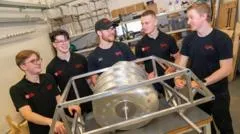
The QUB rover is a 52 kg aluminium-framed machine specifically engineered to withstand the rigours of a simulated lunar environment. To manage the complexity of such a project, the 10-member team divided themselves into three specialised technical groups: software, electronics, and mechanical engineering. This departmentalised approach ensures that each critical component of the robot receives dedicated expertise.
The mechanical team focuses on the structural integrity and physical capabilities of the rover. According to Jack Fitzpatrick, a PhD student in mechanical engineering, their work involves ensuring the machine is physically robust enough to survive the mission environment while maintaining the necessary traction to navigate uneven terrain. Meanwhile, the electronics and software teams work in tandem to bring the machine to life.
The role of software and simulation
Software development is a cornerstone of the rover's autonomy. Jamie Smith, the software team lead, noted that the primary task was transitioning the rover from basic remote control to full autonomous capability. Because physical testing is resource-intensive, the team utilised rover simulations to refine their software algorithms before deploying them on the actual hardware. This digital-first approach is essential for preventing costly errors during the live competition in Florida.
What specific tasks must the robot perform?
The core mission of the rover is to demonstrate autonomous operation within a lunar-simulated room. The robot must be able to determine its own position within a designated area, navigate to a specific excavation point, and perform resource extraction without human intervention. Once the robot reaches the excavation site, it must pick up lunar-simulant sand and deposit it at a secondary location.
This process is not merely a technical exercise but a simulation of the foundational tasks required for long-term space habitation. By successfully moving material from one point to another, the robot demonstrates the ability to assist in constructing the infrastructure necessary for humans to live on the Moon. The ability to build environments autonomously is the driving force behind the competition's existence.
Technical requirements for lunar excavation
To succeed, the rover must balance several competing technical requirements. It needs a digging mechanism capable of handling regolith-like sand, a chassis that can traverse obstacles without tipping, and a sensor suite that provides accurate spatial awareness. The QUB team's ability to integrate these systems—mechanical strength, electronic stability, and software intelligence—will be the deciding factor in their performance at the University of Central Florida.
Why is this competition significant for the UK and Europe?
The QUB team's participation is a landmark moment for European student engineering, as they are the only European team competing in this year's international lineup. Having secured their place by winning a previous competition in Milton Keynes, the students are now tasked with representing the United Kingdom and the broader European engineering community on a global stage against powerhouse teams from the US, India, and Australia.
For the students, the opportunity is about more than just winning a trophy; it is about the practical application of years of academic study. Jack Fitzpatrick described the invitation as a chance to demonstrate everything the team has learned. Even if they do not secure a top spot this year, the team views the experience as a foundational step. They intend to use the data and lessons learned in Florida to build a superior design for future competitions.
The impact on future engineering careers
Participating in NASA-sanctioned events provides students with unparalleled exposure to international standards of engineering. The experience of working under pressure, managing a multi-disciplinary team, and troubleshooting complex hardware in a competitive environment prepares these students for high-level careers in the global aerospace and robotics sectors. For Queen's University Belfast, it serves as a validation of the School of Mechanical and Aerospace Engineering's curriculum.
FAQ: NASA Lunabotics competition
What is the weight of the QUB rover?
The rover designed by the Queen's University Belfast team features a 52 kg aluminium frame. This weight is a critical factor in its design, as the team must balance structural durability with the mobility required to navigate a simulated lunar environment effectively.
Where is the competition being held?
The international Lunabotics competition is being hosted at the University of Central Florida. The event brings together top-tier university teams from across the globe, including participants from the United States, Australia, and India, to compete in lunar simulation tasks.
How did the QUB team qualify for the event?
The team qualified for the NASA competition after winning a precursor competition held in Milton Keynes. This victory allowed the 10-student team to represent the United Kingdom and Europe in the international finals held in the United States.
What are the main technical roles in the team?
The team is organised into three distinct functional groups: software, electronics, and mechanical engineering. The software team focuses on autonomous navigation and simulations, the electronics team handles the rover's circuitry, and the mechanical team ensures structural strength and traction.
What is the ultimate goal of the robot's mission?
The robot's goal is to autonomously navigate a lunar-simulated area, excavate lunar-simulant sand, and deposit it at a new location. This simulates the real-world capability required to build habitats and infrastructure for future human missions on the Moon.
Key takeaways
- The QUB robotics team is the only European representative at this year's NASA Lunabotics competition.
- The rover is a 52 kg aluminium-framed machine designed for autonomous lunar-simulant excavation.
- The team consists of 10 students divided into software, electronics, and mechanical engineering groups.
- The competition takes place at the University of Central Florida against global university teams.
Conclusion
The participation of Queen's University Belfast in the NASA Lunabotics competition marks a significant achievement for UK engineering students. By designing a 52 kg autonomous rover capable of simulating lunar excavation, the team is tackling the very real challenges of future space habitation. While the competition is intense, featuring elite teams from the US, India, and Australia, the QUB students are focused on the long-term value of the experience. Their journey in Florida represents both a culmination of rigorous academic training and a stepping stone toward future advancements in space robotics and international aerospace collaboration.