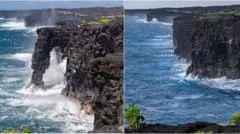
The Hōlei Sea Arch collapse has left a void in Hawaii's coastline, marking the end of an era for one of the island's most recognizable natural structures. This 90-foot-tall lava rock formation, which stood as a testament to the volcanic power of the Big Island, has finally succumbed to the relentless forces of erosion and geological instability. This article examines the circumstances surrounding the collapse, the history of the formation, and the natural processes driving these coastal transformations. Scientists note that such events are inevitable in high-energy volcanic environments.
Geological instability led to the Hōlei Sea Arch collapse
The Hōlei Sea Arch collapse occurred sometime between 23 September and 27 September 2026, according to the National Park Service (NPS). While the exact moment of the fall remains unknown, the landmark was confirmed to be projecting from the coast of Volcanoes National Park on 23 September, but was entirely gone by 27 September. The structure, which stood approximately 90 feet (27.4m) tall, was a massive formation of lava rock that had existed for roughly 550 years.
Geological experts and park officials had long anticipated this event. The NPS stated that the coastline flanking the sea arch had displayed visible signs of instability for several years. In fact, the agency had issued a warning as early as 2021, noting that the arch was destined to crumble into the Pacific Ocean. The collapse is viewed by officials not as an unexpected catastrophe, but as the latest stage in the continuous transformation of the park's rugged and remote coastline.
Environmental factors likely accelerated the final disintegration. It is believed that the arch fell while Volcanoes National Park was temporarily closed due to the impact of Tropical Storm Nolo. The combination of heavy weather and the structural weakness of the cliffs created the perfect conditions for the landmark to vanish.
The impact of volcanic activity and erosion
Structural damage from previous volcanic events played a significant role in weakening the arch's foundation. The NPS reported that earthquakes occurring during the 2018 Kīlauea volcano eruption and subsequent summit collapse had caused substantial damage to the cliffs in the vicinity of the arch. These seismic shifts likely compromised the integrity of the lava rock long before the final collapse.
Erosion from ocean waves has also been a persistent threat to the formation. In January 2020, new cracks and signs of instability in the cliffs forced the park to close the original viewing area for safety reasons. A new viewing area was eventually established at a safer distance to allow visitors to observe the site without risk. Later that same year, waves generated by a tropical storm successfully broke off a significant chunk of rock from the base of the arch, further destabilizing the structure.
The lifecycle of such formations is inherently limited. As the NPS noted in 2021, while the formation is beautiful, it is also temporary. The natural progression of the coastline involves the sea arch eventually crumbling, even as new formations are expected to emerge as the cliffline slowly migrates inland over time.
Tourism and the cultural loss of the landmark
Located at the terminus of Chain of Craters Road on the island of Hawaii, also known as the "Big Island," the Hōlei Sea Arch was a premier tourist destination. Its dramatic silhouette made it one of the most heavily photographed landmarks in the region, drawing thousands of visitors to the edge of Volcanoes National Park to witness its scale.
The loss of the arch has triggered a significant emotional response from the global community. On social media, thousands of people have engaged with the NPS announcement, sharing personal memories and photographs of their visits to the site. The digital reaction highlights the deep connection between visitors and the natural wonders of Hawaii.
The sentiment shared by many reflects a broader philosophical acceptance of nature's volatility. One Facebook user commented on the inevitability of change, noting that "nothing and no one is here forever," urging others to appreciate the beauty of the world while it exists. For the park service and the public alike, the disappearance of the arch serves as a poignant reminder of the constant, shifting nature of the Earth's geological landscape.